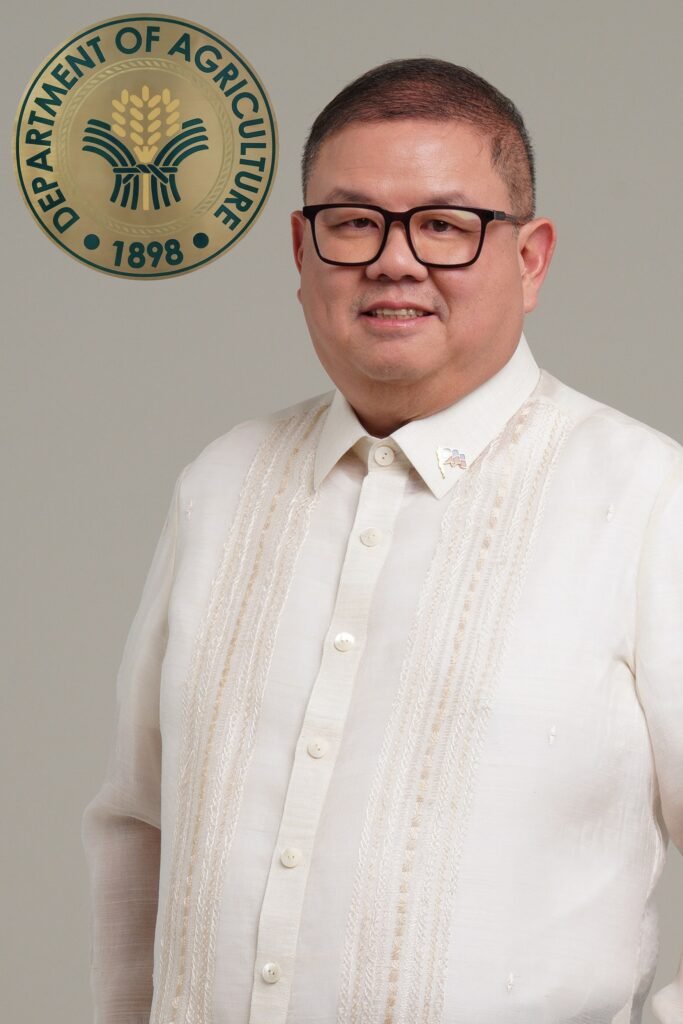
Sec. Francisco Tiu Laurel Jr.: leading Philippine agriculture to a new, bold direction
On November 3, 2023, Francisco P. Tiu Laurel Jr. took his oath as Secretary of the Department of Agriculture before President Ferdinand Marcos Jr.
Before entering public service, Sec. Tiu Laurel built a successful career in business for over 30 years. He led projects in many industries like fisheries, marine services, food processing, cold storage, real estate, and energy. He always pushed for business practices that protect the environment while helping the economy grow.
He played a key role in promoting sustainable fishing, better use of resources, and care for nature. These values continue to guide him as he leads the Department of Agriculture.
Now in government, Sec. Tiu Laurel brings deep knowledge of the agriculture sector and its struggles. His goal is to improve farming and fishing in the country.
He wants farmers and fisherfolk to earn more. He aims to secure the country's food supply and make farming attractive again to the youth.
One of his first big steps was to launch a long-term plan to fix problems that have held back Philippine agriculture. He knows the sector is the backbone of the economy and needs major support.
- His roadmap includes:
- Modern machines and farming tools
- More land and water areas for agri-fishery use
- Stronger transport and storage systems
- Better access to local and foreign markets
- A balance between rules and growth
- Private sector partnerships
Sec. Tiu Laurel believes these goals can only be met through teamwork and clear direction.
With his bold vision, the Department of Agriculture is preparing for a stronger future. One that is modern, competitive, and ready to face new challenges.
First Philippine Republic, American Regime The Department of Agriculture and Manufacturing was formed 11 days after the proclamation of Philippine Independence on June 12, 1898. The Department was one of the first agencies that President Emilio Aguinaldo formed.
The Department was then headed by three directors: Jose Alejandrino (1898-1899), Graciano Gonzaga, and Leon Ma. Guerrero during the latter part of 1899.
In 1901, during the American colonial period, the Department was renamed Insular Bureau of Agriculture under the Department of Interior. It was headed by Americans Frank Lamson-Scribner (1902), W.C. Welborn (1904), and Dr. George Nesom (1907).
In 1910, the Bureau, under the supervision of the Department of Public Instruction, was headed by Frederick Taylor (1911-1914) and Harry Edwards (1914-1916).
In 1917, the Department of Agriculture and Natural Resources (DANR) took over the functions of the bureau and was led by Secretaries Galicano Apacible (1917-1921), Rafael Corpuz (1921-1923), and Silverio Apostol (1923-1928).
Galicano Apacible (1917-1921)
Rafael Corpuz (1921-1923)
Silverio Apostol (1923-1928)
During the administration of Secretary Rafael Alunan, Sr. (1928-1932), the DANR became the Department of Agriculture and Commerce. The Bureau of Agriculture was split into two bureaus: Plant Industry and Animal Industry.
The following year, the Fish and Game Administration and the Fiber Inspection Service were established under the leadership of Secretary Vicente Singson Encarnacion (1933-1934).
From 1934 to 1938, Eulogio Rodriguez, Sr. was appointed Secretary and was later replaced by Secretary Benigno S. Aquino, Sr. until 1941. During Aquino's term, the Fish and Game Administration was restructured and the Division of Soil Survey was created.
With the outbreak of World War II in the Pacific, President Manuel Quezon re-appointed Secretary Rafael Alunan, Sr. (1941-1942) as Secretary of Agriculture and Commerce.
Rafael Alunan, Sr. (1928-1932)
Vicente Singson Encarnacion (1933-1934)
Eulogio Rodriguez, Sr. (1934-1938)
Postwar Period Mariano Garchitorena (1946-1948)
After the country's liberation from the Japanese on July 4, 1945, the government rebuilt the country and reconstituted agencies including the Department of Agriculture and Commerce (DAC). With the resumption of the Commonwealth Government, President Sergio Osmena reappointed Vicente Singson Encarnacion as Secretary of the DAC. Thereafter, Mariano Garchitorena (1946-1948) was appointed by President Manuel Roxas.
In 1947, the Department was named again as the Department of Agriculture and Natural Resources (DANR). In September 1948, President Elpidio Quirino appointed Placido L. Mapa as its Secretary.
Placido L. Mapa (1948-1949)
Two years later, in 1950, Vice President Fernando Lopez served concurrently as DANR chief. During his term, the Bureau of Agricultural Extension, now the Agricultural Training Institute, was established along with the organization of 4-H Clubs and Rural Improvement Clubs nationwide.
In 1953, President Quirino reappointed Placido L. Mapa to lead the Department. Under his tenure, the Rice Economic Board was set up, making the rice industry the first commodity to benefit from integrated national planning.
Salvador Araneta (1953-1955) was later named Secretary. Three major agencies under the DANR were created: the Agricultural Tenancy Commission, precursor of the Department of Agrarian Reform; the Philippine Tobacco Administration, forerunner of the National Tobacco Administration; and the Philippine Coconut Administration, now known as the Philippine Coconut Authority.
Salvador Araneta (1953-1955)
During the latter part of his term, President Magsaysay appointed Juan G. Rodriguez (1955-1960) as DANR chief. His term was highlighted by several milestones: the Philippines became a member of the United Nations Food and Agriculture Organization; the National Rice and Corn Production Program was launched; and the Rice and Corn Coordinating Council, forerunner of the National Agricultural and Fishery Council, was created.
DA Moved to Quezon City On September 14, 1959, the DANR offices moved from Manila at Agrifina Circle to Quezon City along Elliptical Road in Diliman.
When Cesar Fortich became the DANR chief in 1961, the Abaca Development Board, forerunner of the Fiber Development Authority, was created. Jose Locsin, then concurrent Chairman of the National Economic Council, succeeded Fortich from September to December 1961.
Benjamin Gozon (1962-1963)
In 1962, President Diosdado Macapagal appointed Benjamin M. Gozon as Secretary. During his term, two agencies were created: the Bureau of Agricultural Economics, forerunner of the Bureau of Agricultural Statistics; and the National Rice and Corn Administration, now known as the National Food Authority.
The following year, President Macapagal appointed RCA Administrator Jose Y. Feliciano as concurrent Secretary of Agriculture. Feliciano launched the Agricultural Marketing News Service, which regularly provided farmers and consumers prices of selected commodities.
Arturo Tanco, Jr. (1974-1984)
In 1965, President Ferdinand Marcos named Vice President Lopez as Secretary, serving for the second time in a concurrent capacity. Considered as the rice czar, he successfully implemented a production program that enabled the Philippines to export rice for the first time in 1968.
During the early years of Martial Law, in May 1974, President Marcos reorganized and split the DANR into two agencies: the Department of Agriculture and the Department of Natural Resources. Arturo R. Tanco, Jr. was named DA Secretary.
DA Renamed as Ministry of Agriculture Salvador H. Escudero III (1984-1985)
Four years later, government departments were transformed into ministries with the country's shift to a parliamentary form of government.
With Tanco remaining at the helm of the Ministry of Agriculture, the Masagana 99 rice production program was launched, making the country self-sufficient and a rice exporter. A similar corn program also made the country self-sufficient in white corn. In June 1978, the Ministry of Agriculture established 12 regional offices nationwide.
Six years later, in June 1984, the agency was renamed Ministry of Agriculture and Food. The Bureau of Fisheries and Aquatic Resources was transferred from the Ministry of Natural Resources.
In 1984, under a parliamentary government, Assemblyman Salvador H. Escudero III, former Director of the Bureau of Animal Industry and MAF Deputy Minister, served as MAF Minister. Escudero implemented the Intensive Rice Production Program, expanded the government's animal dispersal program, and supported cattle and swine raising programs at the barangay level.
People Power, Renamed to DA Ramon V. Mitra, Jr. (1986-1987)
Carlos G. Dominguez (1987-1990)
Senen C. Bacani (1990-1991)
Roberto S. Sebastian (1992-1996)
In February 1986, as a result of the EDSA People Power Revolution, Corazon C. Aquino became President. She named Ramon V. Mitra, Jr. as MAF Minister, who implemented policy and institutional reforms that freed agriculture markets and enabled farmers to enjoy higher farmgate prices.
In 1987, MAF Deputy Minister Carlos G. Dominguez was appointed to replace Mitra, who opted to run for Representative of the second district of Palawan.
On January 30, 1987, President Aquino signed Executive Order No. 116, which renamed and reorganized the Ministry of Agriculture and Food into the Department of Agriculture.
Under DA, Dominguez introduced reforms in the rural credit system and established the Comprehensive Agricultural Loan Fund. In 1988, he launched the Livelihood Enhancement for Agricultural Development program to speed up farmers' organizations access to financing, management expertise, and marketing. Agriculture and Fishery Councils were set up at sectoral, regional, provincial, and municipal levels to provide inputs on major programs and policy decisions and help plan and monitor DA projects.
Senen C. Bacani, appointed in January 1990, implemented the Rice Action Program and Corn Production Enhancement Program. President Aquino appointed Bacani as Secretary in 1990-1991. His leadership enabled the private sector to take the lead in further developing fresh fruit businesses in resource-rich Mindanao.
In 1992, President Fidel V. Ramos named Roberto S. Sebastian as DA chief. He introduced the Key Production Approach, which became the basis of the Medium-Term Agricultural Development Plan.
In 1996, President Ramos appointed Dr. Salvador H. Escudero III as DA Secretary for the second time. During his two-year tenure, he launched the Gintong Ani food production and security program.
Dar's First Stint William D. Dar (1998-1999)
In July 1998, President Joseph Ejercito Estrada designated William D. Dar as Acting DA Secretary. He introduced the Estrada administration's 10-point agenda in agriculture and fisheries under the Agrikulturang Makamasa program.
In March 1999, President Estrada named former Senate President Edgardo J. Angara as DA Secretary. Angara authored the Agriculture and Fisheries Modernization Act of 1997, or AFMA, and put into motion the law's vision of modernizing the country's agriculture and fisheries sector.
Domingo F. Panganiban continued the implementation of AFMA as the government's comprehensive framework and platform for rural development when he assumed office in January 2001.
A month later, he was replaced by Leonardo Q. Montemayor, who implemented AFMA with special emphasis on social equity. He launched the Ginintuang Masaganang Ani Countrywide Assistance for Rural Employment and Services.
Secretary Luis P. Lorenzo Jr. took the helm at the Department in December 2002 and spearheaded the launching of the Roll-On, Roll-Off transport program. The hybridization programs of the Department were intensified, and interventions were focused on Mindanao regions.
Secretary Arthur C. Yap, appointed on August 23, 2004, continued to uphold the vision of agricultural modernization. During his first term, he unveiled GMA Goal 1, which aimed to develop two million hectares of new lands for agribusiness, and GMA Goal 2, which focused on making food plentiful while keeping prices of wage goods low.
During Panganiban's second term as Secretary, a total of 203,000 hectares of idle lands and 313,000 jobs were developed under Goal 1, and 10 outstanding markets were identified under Goal 2.
When Yap returned to the DA in October 2006, he implemented various projects and policies toward food security and self-sufficiency. When Yap decided to run as Representative of the 3rd District of Bohol, Secretary Bernie Fondevilla took over in March 2010.
Domingo F. Panganiban
Leonardo Q. Montemayor
Luis P. Lorenzo, Jr.
Arthur C. Yap
Proceso J. Alcala
On June 30, 2010, President Benigno S. Aquino III appointed two-term congressman of Quezon and civil engineer Proceso J. Alcala as Secretary. One of the principal authors of the Organic Agriculture Act of 2010, he aimed to achieve self-sufficiency in rice during his term.
Emmanuel F. Pinol was appointed by President Rodrigo Duterte on July 1, 2016. He vowed to bring agriculture and fisheries programs back to basics by addressing food production and poverty. Under his watch, efforts were geared toward production and trade of staple food commodities to ensure food sufficiency and security, and high-value crops to generate jobs and foreign earnings.
Dr. William D. Dar was called again to serve government as Secretary of Agriculture on August 5, 2019 under President Rodrigo Roa Duterte. Upon assuming office, Dar introduced the New Thinking for Agriculture, anchored on the vision of a food-secure Philippines with prosperous farmers and fisherfolk. His battlecry was Masaganang Ani at Mataas na Kita.
As the country's 17th President, Ferdinand Romualdez Marcos, Jr. made the unprecedented decision of designating himself as concurrent head of the Department of Agriculture amid a looming global food crisis. In his inaugural message on June 30, the President noted that the country's agriculture sector cried for urgent attention after years of neglect and misdirection.
His short-term plan focused on increasing the yield of the country's main staple and providing support to those in need of government assistance. Over the long term, he pushed for multi-year planning focused on restructuring the food value chain from research and development to retail. With the support of the DA family, the Department under Marcos' leadership worked to confront challenges that threatened the country's food supply and slowed the growth of the farm sector for decades.